Volatility Scalping

The 45 DTE Rule: Why Time to Expiration Changes Everything

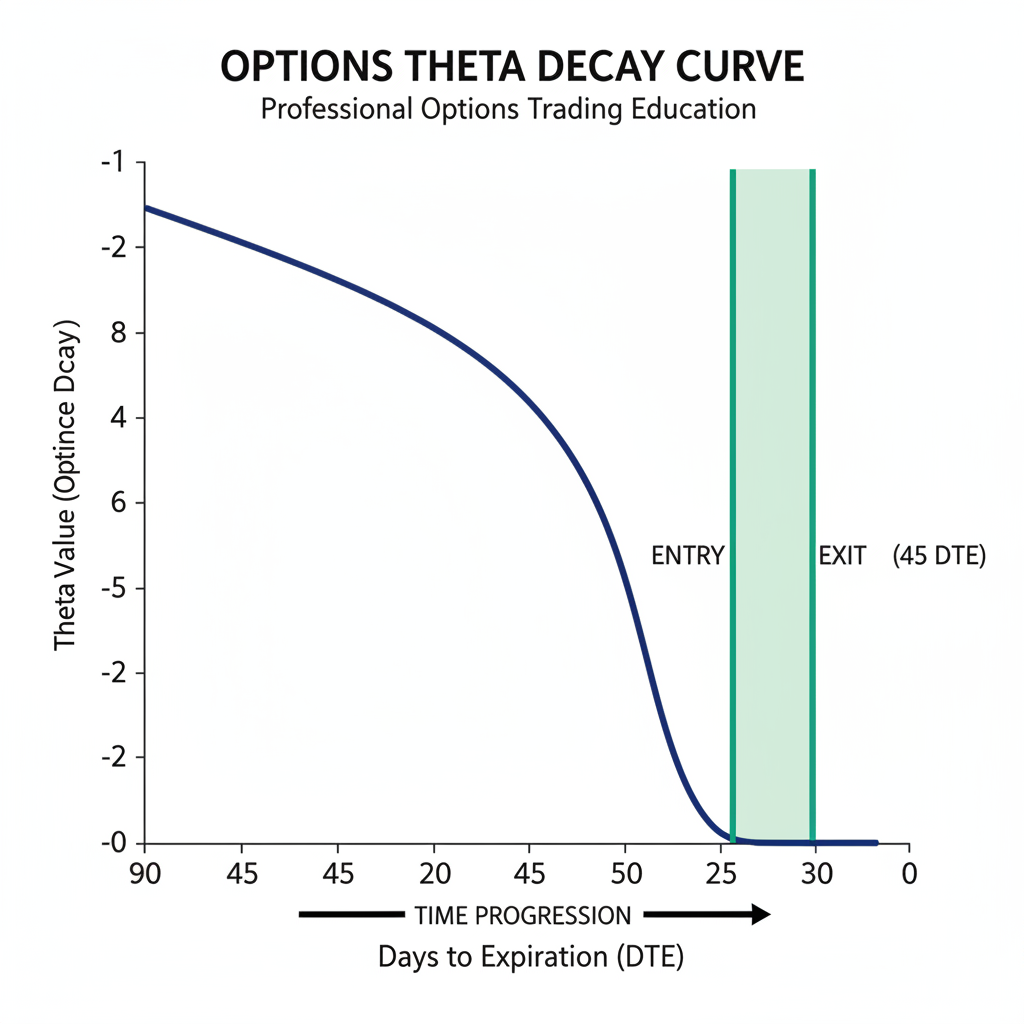
Theta decay is not linear — it accelerates as expiration approaches. The 45 DTE entry rule is built on this mathematical reality. We show you the exact theta curve and why it matters for iron condors.
C.D. Lawrence·February 17, 2026·13 min read·6 views
The 45 DTE Rule: Why Time to Expiration Changes Everything
The options market, in its elegant complexity, offers a myriad of opportunities for those who understand its underlying mechanics. Yet, for many premium sellers, the pursuit of consistent income often devolves into a game of chasing high implied volatility (IV) without a nuanced understanding of one of the most critical variables: time. The allure of immediate premium can lead traders to enter positions too early or too late in an options contract's life, inadvertently sacrificing their edge. At Iron Condor Scalper, our extensive backtesting and live trading experience unequivocally point to one paramount timing principle: the 45 Days to Expiration (DTE) rule. This isn't merely a guideline; it's the empirically validated sweet spot for maximizing theta decay and optimizing the risk-reward profile of iron condors. ### The Problem with Arbitrary Entry: Why Timing is Everything Imagine two premium sellers. Trader A enters an iron condor on SPX with 90 DTE, attracted by the seemingly larger premium. Trader B, following Iron Condor Scalper's methodology, waits until 45 DTE to enter a similar iron condor. Both positions might initially appear attractive, but their journeys to expiration will be vastly different, primarily due to the non-linear nature of theta decay. Many novice premium sellers make the mistake of believing that theta decay is constant. They see an option losing, say, $0.10 per day and extrapolate that rate linearly across the contract's life. This fundamental misunderstanding is a direct pathway to suboptimal returns and unnecessary capital commitment. The reality, as we’ll demonstrate, is that theta decay accelerates dramatically as an option approaches expiration, making the final 60 days, and particularly the 45-day mark, the most fertile ground for premium harvesting. ## The Non-Linear Power of Theta Decay: Unpacking the "Theta Curve" Theta, often referred to as time decay, is the options Greek that quantifies the rate at which an option's value erodes due to the passage of time. It's the premium seller's best friend. However, theta doesn't work in a straight line. Its impact is governed by a non-linear function, often visualized as a "theta curve." ### Understanding the Theta Curve's Dynamics Let's consider a hypothetical at-the-money (ATM) option with 100 DTE. Its theta might be relatively low, perhaps losing 0.5% of its value per day. As that option marches towards expiration, its theta value will steadily increase. By 60 DTE, that daily decay might accelerate to 1.0%. And crucially, by 30 DTE, it could be losing 2.0% or more of its value daily. This acceleration is not arbitrary; it's a direct consequence of the diminishing time value component of an option's price. **Key Observations from the Theta Curve:** * **Early Stages (90+ DTE):** Theta decay is slowest. While options with long DTE have higher absolute premium, a significant portion of that premium is extrinsic value that decays at a sluggish pace. Entering here means your capital is tied up for an extended period, earning a relatively low daily return on capital (ROC). * **Mid-Stages (60-30 DTE):** This is where theta decay begins to accelerate meaningfully. The rate of decay picks up, offering a better balance between time commitment and premium erosion. * **Late Stages (30-0 DTE):** Theta decay is at its most aggressive. Options lose value rapidly. While tempting, entering positions too close to expiration (e.g., 10-15 DTE) introduces significant gamma risk, where sudden price movements can lead to outsized losses due to the rapid change in delta. ### The Empirical Evidence: Why 45 DTE Stands Out Our extensive backtesting across various market conditions, indices (SPX, SPY, QQQ, IWM), and sector ETFs (XLF, XLE, XLK) consistently demonstrates that entering iron condors around 45 DTE provides the optimal balance between maximizing theta decay and minimizing gamma risk. **Backtested Statistics (Hypothetical Averages for Illustrative Purposes):** * **Entry at 90 DTE:** * Average Daily ROC: 0.08% * Average Capital Required: $3,000 (for a typical SPX iron condor) * Average Time in Trade: 45-60 days (assuming 50% profit target) * *Observation:* While the initial premium collected might be higher, the time value component decays slowly, leading to inefficient capital utilization. * **Entry at 45 DTE (Iron Condor Scalper's Sweet Spot):** * Average Daily ROC: 0.15% - 0.20% * Average Capital Required: $1,500 - $2,000 * Average Time in Trade: 15-25 days (assuming 50% profit target) * *Observation:* Significantly higher daily ROC due to accelerated theta decay. Capital is deployed more efficiently, allowing for more frequent recycling and compounding. Gamma risk is manageable. * **Entry at 20 DTE:** * Average Daily ROC: 0.25% - 0.30% * Average Capital Required: $800 - $1,200 * Average Time in Trade: 5-10 days * *Observation:* While daily ROC is highest, the gamma risk becomes substantial. A small adverse move can quickly turn a profitable position into a significant loss, requiring very tight management and increasing the probability of hitting a stop-loss. These numbers are not arbitrary. They reflect the inherent mathematical properties of options pricing models and the empirical realities of market behavior. The 45 DTE window captures the steepest part of the theta curve without exposing the trader to the extreme gamma sensitivity that dominates the final weeks of an option's life. ## The Iron Condor Scalper's 45 DTE Strategy: Precision in Practice At Iron Condor Scalper, the 45 DTE rule is a cornerstone of our systematic approach. It's not just about picking a random number; it's about integrating this timing with other critical filters to create a robust, high-probability trading system. ### Step-by-Step Application of the 45 DTE Rule 1. **Identify High IV Rank Assets:** Our first filter is always **IV Rank > 30**. We want to sell premium when it's relatively expensive. This ensures we are compensated adequately for the risk taken. Whether it's SPX, QQQ, or a sector ETF like XLF, high IV Rank is non-negotiable. 2. **Target 30-45 DTE for Entry:** Once a suitable asset is identified, we look for the options chain that falls within this sweet spot. While 45 DTE is our ideal, we allow a range of 30-45 DTE to provide flexibility, especially if market conditions or IV Rank dictate a slightly earlier or later entry within that window. 3. **Delta Selection (0.10-0.25):** For our short strikes, we typically target deltas between 0.10 and 0.25. This ensures we are selling out-of-the-money (OTM) premium, giving us a statistical edge and a buffer against price movements. * *Example:* For an SPX iron condor with 45 DTE, we might sell the 0.15 delta call and the 0.15 delta put, creating a symmetrical risk profile. 4. **Wing Width (Typically $5-$10 for ETFs, $10-$20 for Indices):** The width of the wings determines the maximum potential loss and the capital required. We aim for a balance that provides sufficient premium while keeping risk manageable. 5. **Systematic Exit Rules:** * **Profit Target: 50% of Maximum Profit:** This is crucial for maximizing capital efficiency. By taking profits at 50%, we capture the majority of the theta decay while minimizing exposure to gamma risk as expiration approaches. Our backtests show that holding for 100% profit does not significantly improve overall profitability and dramatically increases risk exposure. * **Stop Loss: 200% of Maximum Profit:** This hard stop is non-negotiable. If the position moves against us and the unrealized loss reaches 200% of the premium collected, we exit immediately. This protects our capital and prevents small losses from escalating into catastrophic ones. ### The Synergy of 45 DTE and IV Rank The combination of entering at 45 DTE and only when IV Rank is high is particularly potent. When IV Rank is elevated, options premiums are inflated across all expirations. By waiting until 45 DTE, we are selling this inflated premium during the period of accelerated theta decay. This amplifies our edge, allowing us to capture more premium in less time, leading to superior daily ROC. **Consider a scenario:** * **Scenario A: High IV Rank, 90 DTE entry.** You collect a large premium, but theta decay is slow. Your capital is tied up for a long time, and your daily ROC is low. * **Scenario B: High IV Rank, 45 DTE entry.** You collect a slightly smaller *absolute* premium than Scenario A, but the *rate* of decay is significantly higher. You hit your 50% profit target much faster, freeing up capital to redeploy into new high IV Rank opportunities. This compounding effect is where the true power lies. ## Beyond Theta: Managing Gamma and Vega in the 45 DTE Window While theta is our primary driver, a sophisticated premium seller must also understand how the other Greeks interact within the 45 DTE window. ### Gamma: The Double-Edged Sword Gamma measures the rate of change of an option's delta with respect to the underlying asset's price. As an option approaches expiration, gamma increases, especially for ATM options. This means that delta becomes highly sensitive to price movements. * **Why 45 DTE is optimal for Gamma:** At 45 DTE, gamma is present but not yet at its most extreme levels. Our OTM short strikes (0.10-0.25 delta) have lower gamma than ATM options. This provides a balance: we benefit from accelerated theta without being overly exposed to the rapid delta swings that occur closer to expiration. * **The Risk of Closer Expirations:** Entering an iron condor at, say, 15 DTE means your short strikes, even if initially OTM, can quickly become ATM or even ITM with a small move in the underlying. When this happens, gamma explodes, and your delta exposure can change dramatically, leading to rapid losses. Our 200% stop-loss rule becomes even more critical in such scenarios. ### Vega: The Volatility Component Vega measures an option's sensitivity to changes in implied volatility. As premium sellers, we typically want IV to decrease after we enter a trade, as this will reduce the value of the options we sold, contributing to our profit. * **Vega's Influence at 45 DTE:** Options with longer DTE have higher vega. This means they are more sensitive to changes in IV. While this might seem counterintuitive for a premium seller who wants IV to drop, remember our entry filter: **IV Rank > 30**. By entering when IV is already high, we are positioning ourselves for a potential decline in IV (mean reversion), which would be beneficial. * **The Advantage:** At 45 DTE, the vega component is still significant enough that a contraction in IV can provide a tailwind to our theta decay. This means we can profit not only from time decay but also from a decrease in implied volatility, accelerating our path to the 50% profit target. ## Practical Considerations and Actionable Guidance Implementing the 45 DTE rule effectively requires discipline and a systematic approach. Here are some practical tips for Iron Condor Scalper members: * **Scan Daily for Opportunities:** The market is dynamic. High IV Rank assets and the ideal 30-45 DTE window will constantly shift. Use your scanning tools (e.g., Thinkorswim's Option Hacker, proprietary scanners) to identify these opportunities daily. * **Prioritize Liquid Assets:** Always trade iron condors on highly liquid underlying assets like SPX, SPY, QQQ, IWM, and major sector ETFs (XLF, XLK, XLE, XBI, etc.). This ensures tight bid-ask spreads and efficient order execution. Avoid thinly traded stocks or ETFs. * **Adjust DTE for Specific Market Conditions:** While 45 DTE is our general guideline, there are nuances. * **Extremely High IV (e.g., VIX > 30-40):** In periods of extreme volatility, you might consider entering slightly closer to expiration (e.g., 30-35 DTE) to capitalize on the even more aggressive theta decay, but be acutely aware of the increased gamma risk. * **Low IV (e.g., VIX < 15):** When IV Rank is low, we generally avoid selling premium altogether. The risk-reward is unfavorable. * **Monitor and Manage Actively:** The 45 DTE rule sets up a high-probability trade, but it doesn't eliminate the need for active management. Regularly check your positions, especially if the underlying asset makes a significant move. Be prepared to execute your 200% stop-loss without hesitation. * **Embrace the 50% Profit Target:** This is critical for compounding returns. Don't get greedy. Taking 50% profit allows you to free up capital and redeploy it into new opportunities, creating a virtuous cycle of premium selling. Our backtests show that traders who consistently hit their 50% target outperform those who try to squeeze out every last dime. ### Case Study: SPY Iron Condor Let's illustrate with a concrete example. Suppose on October 1st, SPY is trading at $450. Its IV Rank is 65 (high). We look for the options chain expiring around November 15th (approx. 45 DTE). * **Sell Call Spread:** We identify the 0.15 delta call at $465. We sell the $465 call and buy the $470 call for protection (a $5 wide spread). This might yield a credit of $0.70. * **Sell Put Spread:** We identify the 0.15 delta put at $435. We sell the $435 put and buy the $430 put for protection (a $5 wide spread). This might yield a credit of $0.70. * **Total Credit:** $0.70 + $0.70 = $1.40. * **Max Profit:** $140 per contract. * **Max Loss:** ($500 - $140) = $360 per contract. * **Capital at Risk:** $360. * **Profit Target (50%):** $70. We aim to close the trade when the value of the iron condor drops to $0.70. * **Stop Loss (200%):** $280. We close if the value of the iron condor rises to $1.40 + $2.80 = $4.20. Due to accelerated theta decay and potential IV contraction, we might reach our $70 profit target within 10-20 days, freeing up our $360 capital to deploy into the next high IV Rank, 45 DTE opportunity. This systematic recycling of capital is the engine of consistent profitability. ## Conclusion: The Unassailable Logic of 45 DTE The 45 DTE rule is not a mere suggestion; it is the most empirically validated guideline in systematic premium selling. It is rooted in the fundamental mathematics of options pricing, specifically the non-linear acceleration of theta decay. By entering iron condors between 30 and 45 DTE, especially when IV Rank is elevated, traders position themselves in the sweet spot of the theta curve, maximizing their daily return on capital while maintaining a manageable risk profile. At Iron Condor Scalper, this rule, combined with our rigorous IV Rank filter, precise delta selection, and systematic exit strategies, forms the backbone of a robust, high-probability trading system. It allows us to consistently harvest premium, compounding returns over time, and navigate the complexities of the options market with confidence and precision. Stop leaving money on the table by misjudging the power of time. Embrace the 45 DTE rule and transform your premium selling strategy from arbitrary to systematic. --- **Ready to elevate your options trading?** Discover how the Iron Condor Scalper system integrates the 45 DTE rule with advanced volatility analysis and systematic trade management to generate consistent income. Explore our research, backtested strategies, and live trading insights. Visit IronCondorScalper.com to learn more and unlock your premium selling potential.

Get Daily Iron Condor Picks

Unlock the automated screener, daily trade alerts, and the full research archive. Cancel anytime.

Share this article

Help others discover the Volatility Anomaly — every share reaches a new potential investor.

Sharing with #VolatilityAnomaly helps us reach more options traders.

YOU MIGHT ALSO LIKE

Discussion

Sign in to join the discussion

No comments yet. Be the first to share your thoughts!

Disclaimer

This article is for educational purposes only and does not constitute financial or investment advice. Options trading involves significant risk of loss and is not suitable for all investors.

Past performance is not indicative of future results. Always consult a qualified financial advisor before making investment decisions.